

A single day can be the difference between qualifying for a $11,250 super catch-up contribution in 2026 or missing the eligibility window entirely. Most people believe they know their age, but calculating chronological age with professional precision is difficult when you account for leap years and varying month lengths. If you’ve ever struggled to determine exactly how many days old you are for a legal form or a clinical assessment, you’re not alone. Using a reliable age calculator removes the guesswork and prevents the common errors that occur with manual counting.
You’ll learn how to determine your exact age down to the day and why standardized methods, like the ASHA 30-day borrowing rule, are essential for health and legal milestones. We’ll explain the math behind these calculations so you can understand the logic used by professionals. This guide covers everything from 2026 tax deduction eligibility for seniors to the specific birthdate ranges required for school placement. You’ll find the tools and knowledge needed to get an error-free result every time.
Key Takeaways
- Precision is essential for legal and health milestones. Learn how to account for complex variables like leap years and varying month lengths.
- Use a professional age calculator to determine your exact age in years, months, and days instantly without manual errors.
- Plan for future events by calculating your precise age on a specific upcoming date, such as a retirement milestone or 21st birthday.
- Discover how to integrate chronological age data with other health and financial tools to ensure accurate results for BMI and loan metrics.
- Understand the Gregorian calendar standards that provide a consistent global framework for measuring time intervals accurately.
What is an Age Calculator and Why is Precision Important?
An age calculator is a specialized digital tool designed to measure the exact time interval between a person’s date of birth and a specific reference date. While people often think of their age simply in years, this tool provides a granular breakdown into years, months, and days. It serves as a reliable digital assistant for tasks requiring high levels of chronological accuracy. Accuracy is the primary goal, especially when manual math becomes difficult due to the irregularities of the calendar.
Precision matters because time isn’t measured in uniform blocks. A year isn’t always 365 days, and a month isn’t always 30 days. These variations make manual counting prone to error. An automated tool handles these complex variables instantly. It ensures that your calculated age reflects the true passage of time according to the Gregorian calendar. This level of detail is necessary for official filings where a single day can change your legal status or eligibility.
The Problem with Manual Age Calculation
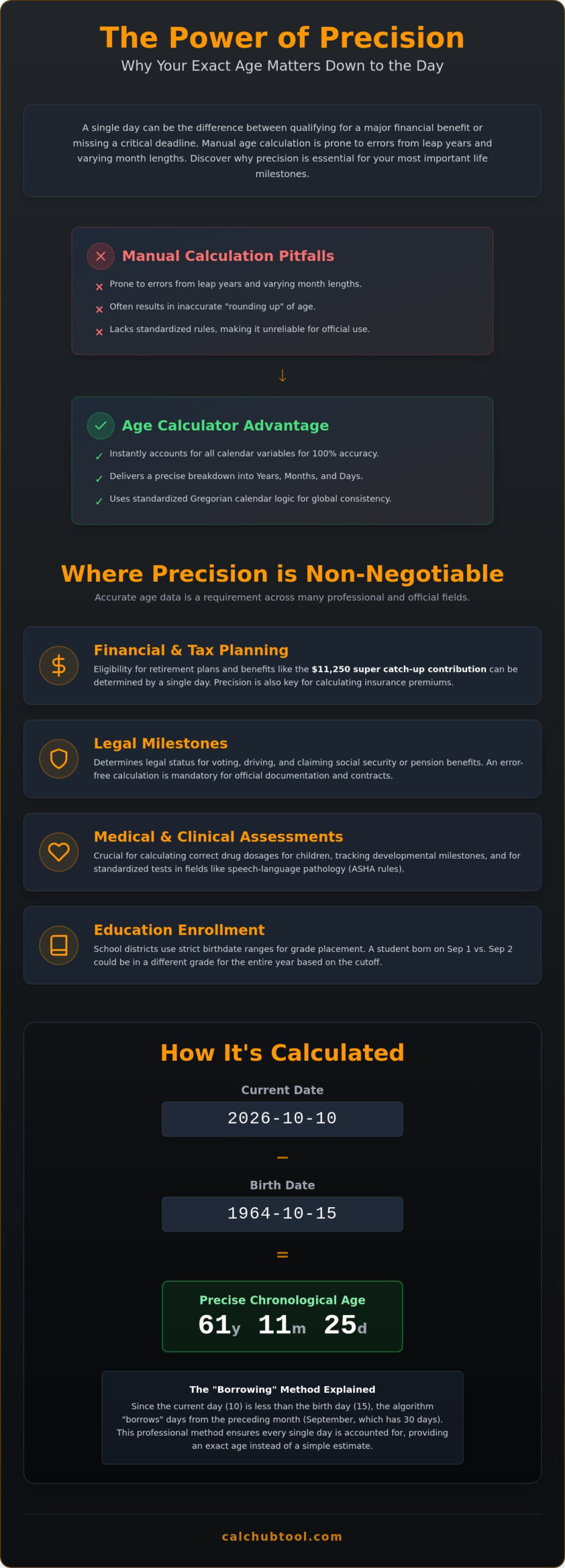
Simple subtraction often fails because it ignores the specific day of the month. If you were born on October 15th and today is October 10th, you haven’t yet reached your next birthday. Manual math frequently skips this detail, leading to “rounding up” errors. Leap years present another challenge by adding an extra day every four years. Without an algorithm, it’s easy to lose track of these adjustments over several decades. Technical systems, such as Wikipedia’s age calculation templates, use specific logic to ensure these dates remain consistent across large datasets. Inconsistencies also arise with month-end dates. Calculating the age of someone born on February 29th requires specific rules that manual counting often lacks.
Common Use Cases for Accurate Age Data
Accuracy is a requirement for many official and professional filings. In the medical field, precise age determines correct drug dosages for infants and toddlers. Educational systems also rely on exact dates for placement. For example, the Los Angeles Unified School District (LAUSD) uses strict birthdate ranges for 2025-2026 school year enrollment. A child must be born between September 2, 2019, and September 1, 2020, to enter Kindergarten. An error of just one day can change a child’s eligibility. Professional assessments in speech-language pathology also use standardized “borrowing” methods to ensure every test result is based on the exact same chronological measurement.
Other critical use cases include:
- Determining legal eligibility for driving, voting, or claiming retirement benefits.
- Calculating chronological age for psychological assessments or norm-referenced testing.
- Tracking developmental milestones in infants to ensure they meet growth targets.
- Calculating insurance premiums where age is a primary variable for risk assessment.
How Chronological Age is Calculated in 2026
Chronological age is the exact measure of time elapsed since birth. It serves as the foundation of all time-based data used in modern record-keeping. Most global systems rely on the Gregorian calendar to maintain consistency across international borders. This calendar system corrected the inaccuracies of previous versions to keep the seasons aligned with the solar year. When you use an age calculator, the algorithm applies these specific calendar rules to find the interval between two dates. It creates a precise timeline that accounts for every passing day without the risk of human error.
The calculation process utilizes a “borrowing” method similar to traditional long subtraction. If the current day is lower than the birth day, the algorithm borrows days from the preceding month. This is more complex than simple math because months have different lengths. A professional tool knows whether to borrow 28, 30, or 31 days based on the specific month in the sequence. This level of detail is essential for how age is calculated in health data. National health statistics depend on this accuracy to track life expectancy and disease prevalence across different age groups. You can use an age calculator to see these logic rules in action instantly.
Western vs. Traditional Age Systems
Western systems set age at zero at the moment of birth. The age increments by one year only on the anniversary of that birth. Some cultures, however, count the nine months spent in the womb as the first year of life. In these traditional systems, a child is one year old at birth. Digital tools standardise to the Western system to maintain compatibility with legal requirements for driving, voting, and employment. This ensures that a person’s age is recognized consistently by government agencies and international organizations.
Handling Leap Years and Calendar Anomalies
Leap years add a 366th day to the calendar every four years. This adjustment aligns the calendar with the Earth’s orbit around the sun. An accurate tool automatically identifies these years and adds the extra day to the total count. This prevents a drift in accuracy over long periods. For individuals born on February 29th, the tool must resolve the dilemma for non-leap years. It typically counts the birthday as February 28th or March 1st depending on the specific legal jurisdiction or calculation rule selected. This automated resolution removes the confusion often associated with leap-year birthdays.
Calculating Age on a Specific Date for Planning
Users often need to determine their age on a future date to prepare for major life events. An age calculator allows you to input any target date to see exactly how old you will be at that moment. This feature is useful for counting down the days until a 21st birthday or a planned retirement date. It removes the uncertainty of manual counting and provides a precise result in seconds. You can set the “calculate at” date to any point in the future to visualize your timeline clearly.
Historical and genealogical research also requires calculating age on past dates. You might need to know a relative’s exact age during a specific census or a significant historical event. This helps in verifying the identity of ancestors in public records. Travel visa applications frequently ask for your age as of the arrival date in a foreign country. Entering these specific dates into the tool ensures your documentation is accurate and compliant with international regulations. It prevents errors that could lead to application delays or rejections.
Planning for Legal and Financial Milestones
Verifying your age for future financial benefits is a critical task for long-term security. In 2026, the standard IRA contribution limit is $7,500, but individuals aged 50 and over can contribute an additional catch-up amount of $1,100. Furthermore, those aged 60 to 63 qualify for a “super catch-up” contribution of $11,250 to eligible retirement plans. You must know exactly when you enter these age brackets to maximize your tax-advantaged savings. Check your eligibility for Social Security or specific pension start dates by calculating your age on those future milestones. Once you verify your age and eligibility, use our Loan Calculator to plan your finances and debt management strategies. Precise age data also helps when verifying requirements for insurance policy renewals or new coverage options.
Educational and Developmental Tracking
School districts use strict “cutoff” dates for grade placement and enrollment. For the 2025-2026 school year, the Los Angeles Unified School District requires children to be five years old between September 2, 2019, and September 1, 2020, to enter Kindergarten. Using an age calculator helps parents determine if their child meets these requirements before starting the enrollment process. For younger children, tracking age in weeks is necessary for pediatric health assessments and developmental milestones. Sports leagues also use these precise calculations to place athletes in the correct age brackets. This ensures fair competition and adherence to league safety regulations.
How to Use the Calchubtool Age Calculator
Calchubtool provides a fast, ad-supported interface designed for immediate functionality. The age calculator is fully optimized for both desktop and mobile web browsers. This ensures you can access the tool from a smartphone while on the go or from a computer at your desk. You don’t need to create an account or provide personal data to use the service. There is no subscription fee and no requirement to share your email address. This creates a transparent and secure environment for performing quick calculations. The tool processes your input immediately to provide a comprehensive breakdown of your age across multiple time units.
Step-by-Step Calculation Guide
Follow these three steps to get your results. First, enter your Month, Day, and Year of birth into the first designated field. Use the dropdown menus or type the numbers directly to ensure the data is correct. Second, select the “Age at the Date of” field. This defaults to the current date, but you can adjust it to any past or future point in time. Third, click the “Calculate” button to generate your detailed report. The system processes the data in less than a second. This streamlined flow ensures that you can find the information you need without any unnecessary delays. Use the age calculator to get your exact results now.
Interpreting Your Results
The output is organized to be scanned quickly. The primary result shows your chronological age in years, months, and days. This format is the global standard for legal documents, insurance applications, and school enrollment. Below this main figure, you will find a list of secondary metrics. These include your total age expressed in weeks, days, hours, and minutes. You can use these specific figures for social media milestones or detailed health logs. For example, knowing your age in total days is a popular way to celebrate personal growth milestones. The tool also accounts for leap years automatically, so the day count is always perfect.
The data is presented in a clean, declarative style that avoids complex jargon. This makes the results accessible to everyone, from parents checking school eligibility to professionals needing data for clinical assessments. Because the tool requires no login, you can perform repetitive calculations for different people or dates without interruption. Every result is based on the Gregorian calendar rules, ensuring your data remains consistent with international standards.
Integrating Age Data with Other Health and Finance Tools
Age is a primary variable in many utility calculations. It serves as a filter for categorizing data in health, finance, and professional development. Once you determine your exact results using an age calculator, you can apply that data to other specialized tools. Calchubtool provides a suite of interconnected calculators designed for total life management. This systematic approach ensures that every metric you track is accurate and relevant to your current life stage. You don’t have to guess which age-based regulations apply to you when you have the exact numbers ready.
Using an age calculator is the first step in a larger process of data organization. By establishing your exact chronological age, you create a reliable baseline for all other life metrics. Whether you’re planning for retirement, tracking a child’s development, or optimizing your health, precision is the key to success. Calchubtool offers the tools needed to navigate these complex requirements with ease. Every calculator in the toolkit is built to provide instant, error-free results that help you make informed decisions about your future.
Health and Wellness Calculations
Biological needs change as you move through different decades. Your age directly influences your basal metabolic rate and your daily sleep cycle requirements. For example, infants require significantly more sleep than adults, and metabolic efficiency often shifts as we age. Precise age is also necessary for determining standard medical categories. Check your BMI Calculator results using your new age data to ensure you are in the correct health category. You should also use the Sleep Calculator to optimize your rest based on your specific life stage. These tools work together to provide a comprehensive view of your physical well-being.
Financial and Professional Planning
In the financial sector, age determines your “time horizon” for investments and net worth growth. Lenders use age to help determine loan terms and interest rates, as it reflects your career stage and earning potential. Understanding where you stand chronologically helps you set realistic savings goals. For instance, in 2026, the IRS allows catch-up contributions for those aged 50 and over, including a $1,100 IRA catch-up. Use our Percentage Calculator to track age-based growth metrics for your retirement accounts or personal savings. Professional development also benefits from age-based tracking. You can calculate your professional “typing age” to identify areas for improvement in your career skills. This data-driven approach helps you stay competitive in the modern workforce.
Secure Your Chronological Accuracy Today
Reliable age data is a fundamental requirement for navigating modern legal and health systems. You’ve seen how professional logic accounts for leap years and varying month lengths to prevent costly manual errors. This precision ensures you meet specific eligibility windows for retirement contributions and educational placements. By using an automated age calculator, you maintain consistency across all your personal records. This data serves as a vital input for other essential metrics like BMI and financial loan terms.
Take the guesswork out of your planning with a tool designed for immediate functionality. Calchubtool provides a free utility tool for 2026 that uses comprehensive date-interval logic to deliver perfect results. You can access these insights instantly without the need for sign-ups or sharing personal data. Calculate your exact age now on Calchubtool to get the clarity you need for your next milestone. Start organizing your life stages with confidence and precision today.
Frequently Asked Questions
How does an age calculator handle leap years?
An age calculator automatically identifies leap years within the date range and adds a 366th day to the total count every four years. This adjustment ensures that the conversion from years to total days remains perfectly accurate over long periods. Without this logic, manual calculations would drift by one day for every four-year cycle. The tool handles this math instantly to maintain chronological precision.
Can I calculate my age on a specific future date?
You can calculate your age on any future date by adjusting the reference date field in the tool. This is a common feature used for planning retirement milestones, travel visas, or insurance renewals. Simply enter your birth date and the specific future date to see your exact results. It removes the guesswork from determining your eligibility for upcoming legal or financial events.
Is chronological age the same as biological age?
Chronological age is the exact measure of time elapsed since birth based on the calendar. Biological age refers to how old your body appears based on health markers and physical condition. Our tool measures chronological age only. Biological age requires medical assessments of variables like cardiovascular health and DNA markers, which cannot be determined through a simple calendar calculation.
Why do some age calculators give different results for months?
Discrepancies occur because different tools use different logic for “borrowing” days when a birth day exceeds the current day. Some systems treat every month as exactly 30 days, while more precise tools use the actual number of days in each specific month. The age calculator on Calchubtool uses Gregorian calendar standards to ensure your results are consistent with official and professional requirements.
What is the “Korean Age” system and how does it differ?
The traditional Korean age system considers a baby to be one year old at birth and adds a year every New Year’s Day. This differs from the Western system, which starts at zero and increments on the actual birthday. South Korea officially adopted the international standard for most legal and administrative purposes in June 2023. However, the traditional system is still occasionally used in informal social contexts.
How many days have I been alive?
The tool provides a detailed breakdown of your total days lived in the secondary metrics section of the results. This figure is calculated by totaling the days in every full year and adding the specific days from the remaining months. It includes all leap day adjustments to provide a perfect count of every 24-hour period. This metric is often used for personal milestones or health tracking.
Is the Calchubtool age calculator free to use?
The Calchubtool age calculator is entirely free and does not require a subscription or account creation. It is an ad-supported utility designed to provide immediate functionality for all users. You can perform as many calculations as needed for different individuals or dates without any hidden costs. The tool is available 24/7 through any standard desktop or mobile web browser.
Do I need to include the time of birth for an accurate age?
Including the time of birth is not required for a standard age calculation in years, months, and days. However, providing the exact time allows the tool to calculate your age down to the precise hour and minute. If you don’t know the exact time, the system defaults to the start of your birth date. This level of detail is usually optional for most legal and professional forms.